
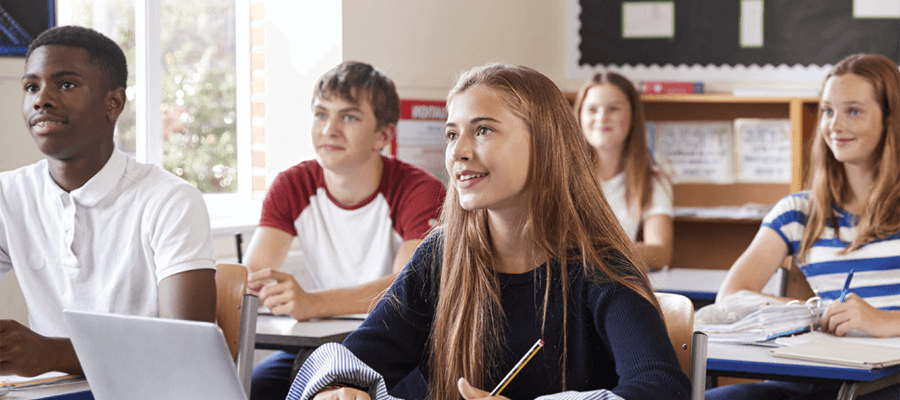
Silent, except for the occasional squeak of a chair, twenty middle school students survey the room, wondering who will speak first. We’ve been reading, annotating and preparing questions about our class novel.
Then, with a deep breath of trepidation, one student begins with a question. She suggests her own answer, plunging the class into our novel discussion. Eyes turn towards another student, as he responds with his own take, a polite disagreement that complicates matters for the class. A neighbor follows up, asking him to elaborate and clarify. As others eagerly join in, I listen with joy and relief. Our discussion has begun.
This is just a quick glimpse into our classroom where discussions like the one described are imperative to student learning. Discussions help students to engage with the content and explore it on their own, allowing them to take risks. While I may have provided the book for them, they decide where to go with it. Learning becomes a thrill, not something that “the teacher made us do.” It gives them a sense of ownership as well as the ability to learn from each other. Something that their classmate pointed out might become a key feature in their essay that analyzes the book. In this way, their learning truly becomes their own.
Cultivating an environment that supports this type of inquiry is crucial and a main part of what parents consider when deciding on options for school. The reasons we can have discussions is exactly the reason why families continue to choose private education. Our small classroom size of roughly twenty students per class means each student has the time and space to breathe and participate. More than that, since I’ve known some of their families for a few years, there’s a sense of safety in the risk of navigating controversial topics since we have shared many of the same values. After class, I continue to support them with specific feedback to encourage developing ideas and I send emails to families at home about our main topics, with hopes that the conversation continues even outside the classroom.
Even if they don’t continue elsewhere, these discussions are powerful moments, not just for the students, but also for me. It gives me a vision of hope for the continuation of the community that these students will one day lead and vote in. And on that day, the deep breath before the plunge will not be one of trepidation but one of confidence in applying what they have already learned.
By Daniel Araujo, 7th & 8th English Language Arts Teacher at Contra Costa Christian School